
Simon van Gend discusses his record, Dream I’m A Bird.
🎙️ Episode Summary
In this episode, Tim sits down with veteran songwriter and artist Simon van Gend to discuss his 2025 album, Dream I’m A Bird. After a decade-long hiatus since his last release, Simon reveals how a high-pressure “song-a-week” challenge in 2017 provided the raw material for an album that took nearly eight years to mature.
We dive into the “musical archaeology” of his writing process, the respectful listening culture of Cape Town’s best venues, and why sometimes, the best album art is the piece you’ve already painted.
🎧 Key Takeaways
- Quantity Leads to Quality: Writing 52 songs in a year allowed Simon to curate the very best 15 for the album, proving that bypassing the “inner critic” is essential for raw creativity.
- The “Frontal Cortex” Curse: A deep dive into why animals might have the edge on us when it comes to mindfulness and living in the moment.
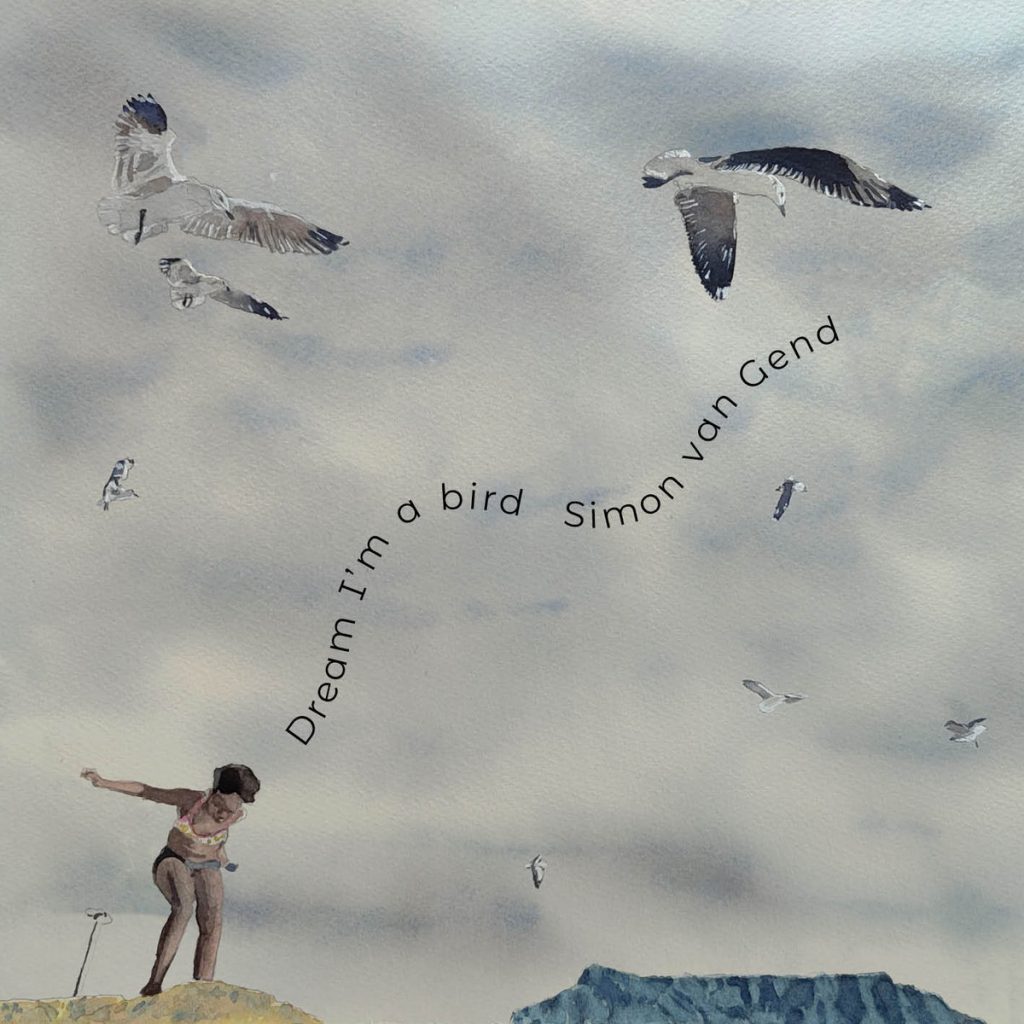
- Creative Serendipity: How a watercolor painting and a 20-minute session in InDesign solved a months-long headache over album artwork.
- The Ethics of the “Murder Mouse”: A fascinating look at the cognitive dissonance we face regarding animals, vermin, and the songs we choose to sing (or skip).
⏱️ Timestamps
- [00:00] Introduction: The 8-year flight of Dream I’m A Bird
- [01:04] Sold out at Café Roux: Creating a “listening” culture in Cape Town
- [03:50] The Decade Gap: Balancing day jobs, recording costs, and Dirk Hugo’s studio
- [06:50] Drawing on the Right Side of the Brain: How painting transformed the album
- [10:20] “Hope for Aging Folk” and the pressure of settling down
- [11:16] The Plectrum Box: A Christmas gift and the mystery of lost picks
- [12:22] The “Murder Mouse” Controversy: Why a song was cut from the setlist
- [16:38] Animal Wisdom: What dogs can teach us about escaping our thoughts
- [20:58] Standout Tracks: “Satellites” and the dream-logic of “Jet Lag Boy”
- [24:07] Closing: Upcoming 2026 tour dates and where to find Simon’s art
🔗 Links
- Website: simonvangend.co.za
- Bandcamp: simonvangend.bandcamp.com
- Instagram: @simonvangend
- YouTube: @simonvangendband
📃 Transcript
Tim Smal [host]: Hi everyone, and welcome to the show. My name is Tim Smal, and today on the show, I have my guest, Simon van Gend. Simon van Gend is a songwriter who has spent two decades crafting a sound that is as much about the silence between the notes as it is about the lyrics themselves. His latest record, Dream I’m A Bird, is a fascinating piece of musical archeology. The seeds of these songs were planted back in 2017 during a grueling song-a-week challenge, a high-pressure exercise in raw creativity, where Simon forced himself to bypass the inner critic and just write. But while the writing was fast, the incubation was slow, these tracks have spent nearly eight years maturing, shifting, and gathering weight before finally taking flight in 2025. Simon, welcome to the show.
Simon van Gend [guest]: Hello.
[0:55] Tim: Great to have you here today. First things first, I attended your recent show at Café Roux. What a spectacular sold-out show. Tell me more.
[01:04] Simon: We were very chuffed with how it went, obviously, filling the place. And Café Roux is just such a great venue. They’ve got a really good sound system and a dedicated sound guy who does a great job. It’s just really great to have a music venue that is totally focused on the music. I did notice when I arrived there, they had little signs on the tables telling people to be quiet and listen to the music, which is always really nice for the musicians because there is a bit of a culture in some places where you come to play the music and you’re treated very much as background music.
I’ve actually had comments from friends of mine who’ve performed overseas, for example, in Europe, and they say that the culture is just so different there. When a musician steps up on a stage in Europe, people are so respectful. We do have a few venues in Cape Town which have created that culture. So Café Roux is a good example. Another good example is Alma Cafe, obviously. But yeah, there do seem to be more venues that treat musicians with that kind of respect, which is really great. So yeah, well, anyway, hats off to Café Roux. I’m very keen to go and play more gigs there.
[02:23] Tim: Yeah, I’m glad to hear that you had a good show there. You had your full band with Ross Campbell on drums, Crick Lund on bass, Gustavo Fasani on keyboards, and Drew Burton on trumpet. Now, it’s been over a decade since your previous release, Suffer Well, came out in 2015. So for me to hear songs off your new record, Dream I’m A Bird, that was amazing for me because there are a whole bunch of new tracks that are sounding absolutely amazing. What was it like for you to play these new tracks live?
[02:51] Simon: Yeah, well, it’s always nice to play to a good audience. The audience makes all the difference. So that Café Roux show was just so great because the room was full of people who had come there specifically to hear my songs. And I could tell from the end of the first song, just the response of the audience was so great. And it really helps a performer if you know that what you’re doing is being appreciated and it just makes you perform better, I suppose. And it makes you relax and enjoy yourself. So it was really nice to do that show. And I really hope we can do more like that.
[3:31] Tim: Amazing. Well, the first song that you opened up with is also the first song off your new album. It’s called Why, Why, Why? And so I thought I would ask you why has it taken so long for a new record to come out? Maybe you can tell me a bit more about the gap between your two last records.
[03:50] Simon: I guess one gets swept up in one’s life and it’s very easy to just let time pass you by without really writing a lot of songs. As you said in the intro, I wrote most of these songs in 2017. And I guess kind of what happened is we had all these songs, which I had written in 2017 and we needed to record them. And I was kind of struggling to find a way to record them that wasn’t going to cost me too much, but that also wasn’t going to compromise on quality. And yeah, it’s a number of things, I suppose. You know, everybody in the band has day jobs and we’re all very busy. So finding the time and the money to record an album isn’t actually all that easy these days.
Yeah, so a friend of Ross’s, Dirk Hugo, he’s a guy who has a very nice setup at his house with really nice gear, and he records bands that he likes. More as a hobby than trying to make a living from it. He doesn’t charge anything, but he’s very good. And he just said to me he’d be happy to record an album. So that was a great solution for us. Yeah, so we just started the process and workshopped the songs. And I had the 52 songs from 2017 and then a few more, which I’d written in the interim. And so the first step was to decide which of those were going to make a good album. And I guess that’s the advantage of doing this thing, of writing a whole lot of songs, far more than you need, means that when it’s time to make the album, you can really pick and choose and find the best bunch that hang together well as an album.
So yeah, I’m kind of busy engaging with a similar process. I haven’t actually set a deadline for myself this year to write a song a week, partly because I’ve got so much work to do with my day job. But I’m kind of getting into that headspace again, of just writing a lot of songs, and I’m working up to writing more and more songs so that we can make another album.
[06:05] Tim: I love going on bandcamp.com and reading the lyrics to each of your songs because there’s a lot to explore there, right? And I’d love to talk about all of the songs on the record. Of course, we don’t have enough time to chat about all 15, but there’s certainly a couple of tracks that I loved on this album, and I want to dive a bit deeper into them. So the second one I thought I would chat about is, of course, the title track, Dream I’m A Bird, because you’re an artist and you do a lot of paintings, and the fans can see that on your website. But I believe that you painted a picture, or should I say a watercolour painting of a bird, and then that inspired the album artwork for this record. Can you tell me more about the song?
[06:50] Simon: So about… must be three years ago now, I started doing a bit of drawing and painting. There’s this very good book called Drawing On The Right Side Of The Brain. It’s a drawing course, but it’s a book you can buy and you find it in secondhand bookshops. And if you follow the steps in the book, you can turn yourself from somebody who doesn’t know how to draw into someone who can draw really well from life. And I did the course back in my 20s and I learned to draw. And I was blown away by this idea that there are all these capacities we have, which we think some people are just born with and others aren’t. And you do a course like that and you realize, “Sherbet, there’s so much we can do, but we just never learned how to do it.” And it was really empowering for me to do that.
And so, about three or four years ago, I decided to go through that book again and redo the course and remind myself what I’d learned and I learned to draw all over again. And then I just got really into it and I thought, “Well, why not bring colour into it?” So I got into watercolour and I basically paint from photographs that I take. And it just became something that I was quite obsessed with for a few years. And I did a whole bunch of paintings and yeah, I ended up taking my dog for a walk on Milnerton Beach a lot because I used to go off to the climbing gym at City Rock. And then afterwards, I’d take the dog to the beach and just that stretch of beach with the seagulls and the people and the mountain in the background became one of my favourite subjects for taking photographs and then painting.
Yeah, so I had this painting of a photo that I’d taken over there of just some people playing around and some seagulls above them in the air. And the painting came out really well. And once we’d made the album, I needed artwork for it. And usually making album artwork is quite a drama. You’ve got to find an artist and commission it and go back and forth and back and forth. And it can take a month or two to finally come up with album artwork that you’re happy with. And I was just wondering what to do. And I came across this photograph of the painting on my computer, pulled it into InDesign, because I work in InDesign. So that’s what I do for a living. And within 20 minutes, I had an album cover. And I thought, “Of course, the album is called Dream I’m A Bird, because this painting looks like someone who’s dreaming they’re a bird. It was quite serendipitous.
And yeah, it was a big relief. Suddenly, after 20 minutes of wondering what I’m going to do, I had an album cover and I had the artwork all done. And it was great. So yeah. But yeah, so the reason the album is called Dream I’m A Bird, isn’t necessarily because the song Dream I’m A Bird was such an important song on the album. It was more because it came together nicely with the artwork. Yeah, so that’s that.
[10:06] Tim: Great. And another track that you’ve actually shot a music video for, which everyone can find on YouTube, is a track called Hope for Aging Folk, which is a really nice upbeat gem of a tune. Maybe you can tell me more about that one.
[10:20] Simon: So again, that’s a song that the words just kind of spilled out of me. I don’t really know why I came up with that chorus “She was hope for aging folk,” except that I was probably thinking about one of my ex-girlfriends, who… I’d always have this situation would arise with my parents, where I would bring a girl around, and it would be like, “Yay, finally Simon is settling down.” And she would be hope for them, Hope for Aging Folk. And I would disappoint them, because I couldn’t settle down yet. So yeah, that’s more or less what that song was about.
[11:16] Tim: Interesting. Well, I loved hearing more stories from Simon van Gend at your previous gig, and one of the stories you told was how your girlfriend made you a birthday present by, I believe she bought you a bunch of guitar picks or a pick holder that she made, something to that effect?
[11:32] Simon: Yeah, no, that was for Christmas. She bought me a little box that she had made. I believe she found a website that does this, where you can order a custom-made plectrum box, and it’s got my name on it, and it’s made out of wood, and it’s a beautiful little box, but it holds three plectrums. Yeah, the thing about being a guitarist is you’re always losing plectrums because they’re so small. They’re these tiny little cheap, well, not so cheap anymore, pieces of plastic, and they slip down behind the cushions of the couch, or get eaten by the dog, or whatever, but they’re very easy to lose. But if you have them in a little box, the box is much harder to lose. So yeah.
[12:22] Tim: Amazing. Well, what a thoughtful gift from your girlfriend and it made a great story at the show. It’s really interesting attending your live shows because even though the audience are very quiet during the songs, they love to kind of get involved in between the songs when you’re telling your stories. And there’s a couple of good chirps from the audience, a lot of good laughs. And one of the chirps that really made me laugh during your previous gig was someone shouted out, “The Mouse Song.” And then I knew what they were referring to because it’s another track on your record called Murder Mouse Blues. And it’s actually a really, really cool track, quite different to the others. It’s got this kind of eerie keyboard sound to it. And it’s very groovy and has almost a kind of a reggae feel. So I saw the look on your face when you thought to yourself “Oh, man. We haven’t practiced that one for the gig, but clearly it’s a banger that the crowd wants to hear.” So tell me more about that.
[13:17] Simon: OK, so yeah, what happened with that song, you know, it’s actually usually part of our set list. But I got a WhatsApp from a friend a week before the gig, who said she’s bringing three or four people with her to the show, who are serious like animal rights activists, you know, like ‘off the charts’ concerned about hurting animals, which, you know, I am too, by the way, but anyway. And “Please would I not sing that song?” And my initial reaction was like, “Come on, really?” You know, it’s like… it’s not really a song that’s celebrating the murder of mice. I wrote the song partly out of the conflict that it stirred up in me that I did kill a mouse in the middle of the night once. What do we do about vermin, you know, that we share our space with, you know, everyone is confronted with this issue of rats and mice in their houses. And, you know, I really think rats and mice are little conscious beings. They’ve got a life of their own, and it’s not cool to kill them, but can we coexist with them, you know?
And I was being kept awake one night by a mouse that was trying to find its way out of my room. And it kept waking me up going till like three in the morning. And eventually I cornered it and found a mouse trap and set the trap, and the trap killed the mouse. And I was a bit shocked by what I’d done, you know? But it’s a funny thing, ninety percent of us happily buy meat from a supermarket that was killed by somebody, you know? And we live with this disconnect all the time between the murdering that we’re doing and our feelings about murder. And that is why I wrote the song, you know? Because I’d murdered a mouse and it was consequential. So the song itself, it’s not a celebration of murdering mice, you know? It’s more me saying like, “s***, what have I done?” And so I did feel a little bit annoyed that someone was saying, I shouldn’t sing the song because there are sensitive people in the audience. But at the same time, I thought, “f*** it, you know, I’ve got lots of other songs. So let’s just skip that one for the show and rather not cause a fuss.” But anyway, that song will definitely be on the set list at future shows.
[16:04] Tim: Wow. What an interesting story. I never expected to hear such an intricate response to that question. But yeah, I mean, that’s so interesting. I guess we’re going to have to put a ‘parental advisory’ sticker on the new Simon van Gend album.
[16:22] Simon: Yeah.
[16:23] Tim: But actually, it does raise another question because I noticed in your track list that there are a lot of songs that reference animals. You’ve got Dream I’m A Bird, Murder Mouse Blues, and there’s another track called Animal, What’s The Way? So maybe tell me more about that one.
[16:38] Simon: Yeah. I mean, someone pointed this out to me actually recently that there are a lot of birds in my songs and I wasn’t really conscious of it. I sing about sunbirds and the nightjars and the owls in my one song. The song Animal, What’s The Way?, probably had to do with me and my dog. I had a dog at the time who subsequently died, but I was very attached to this border collie called Coco. And I guess also, when I was a child, we had a dog who I was very attached to. And I’ve spent a lot of time looking at the dog, wondering how it is to be a dog, like what’s its existence like? And it seems to me that animals are free of something that we are cursed by, which is this thinking about thinking.
So our brains have this capacity to think about what we’re thinking about, and to think about everything. We think about so much stuff. And it gives us all this amazing creativity and ability to create technology and have a story that we tell ourselves about ourselves and about each other. And animals, as far as I can tell, don’t have very much of that going on. You know, they might have a little bit of it. But when you see a dog lying in the sun, sleeping half the day away, I don’t think he’s or she is anxious about “Are they going to die one day?” You know, which is something that human beings will lie in bed at night, I certainly do, and think, “How many more years have I got left?” And, you know, we’re aware of what’s coming 20, 30 years down the line. At some point in your childhood, you see a dead animal and you realize, like, that’s going to be me one day, you know?
Yeah, I guess the song is exploring what can an animal teach me about how to exist? How can I free myself from this… it’s basically our frontal cortex, the part of our brain that differentiates us so strongly from animals. The higher apes have it to a degree, but it’s super developed in humans, and it’s this part of our brain that does all this logical thinking. And there are moments in my life where I somehow bypass it. Through things like meditation or just mindfulness, and I think, you know, that’s kind of the whole goal of mindfulness, is to try and become more like an animal, where you’re just kind of living things as they happen, rather than watching things happen and thinking about them.
So, yeah, that’s really what that song is. It’s kind of just asking that question, “Animal, what’s the way to free the soul? What can you teach me?” And I do think that’s maybe why we love to have pets, like dogs and cats, because when you interact with a dog or a cat, it kind of puts you right in the moment. Because you’re no longer in the world of your own thoughts about thoughts. You’re just there with the dog. And it connects you directly to something far simpler and more elemental.
[20:32] Tim: Awesome. And I’m interested to know if out of these 15 songs, there are perhaps one or two that are standout tracks for you that are particularly special to you, that have a special place in your heart?
[20:46] Simon: Oh, yeah, I think Animal, What’s The Way? is one of my favorites. Oh, and another one that I really like is Satellites.
[20:58] Tim: Yeah, Satellites is also one of my personal favorites on the album, so I’m glad you brought it out. It’s got some really memorable lines in there like, “I read all your letters from London.” And I guess I just have to ask about one more song if that’s all right, because you played it live at the concert, and so clearly it’s another banger, if you will.
[21:20] Simon: Oh yeah?
[21:21] Tim: It’s called Jet Lag Boy.
[21:23] Simon: Oh, okay. Sjoe, again, you know, it’s very hard for me to say who or what it’s about. It’s another song that just kind of came together like a dream. When I do try and think about “Who am I writing about?”, it’s possible Jet Lag Boy… well, I had a friend at the time who was traveling a lot, and he was just flying all over the world playing music, actually, and he’s a very successful musician. And, yeah, I guess it might have been the part of me that was envious of him coming into that song, and who knows what my unconscious was up to around who that Jet Lag Boy was. These songs are like dreams. I don’t really take full responsibility for who and what they’re about.
And I guess that’s kind of what I’ve always loved about songs that I love of other people’s, like Paul Simon, Bob Dylan, Neil Young – their best songs, the lyrics are like dreams. They’re just wild, full of wild imagery, and they allow you to dream your own dream when you listen to them. So that’s all I can really say about Jet Lag Boy. It’s not about a particular person necessarily, but more about a bunch of feelings, you know?
[22:56] Tim: Interesting. Yeah, I’ve really enjoyed learning more about all the songs of your new record, Dream I’m A Bird. You know, I love to listen to the record when I go walking on the promenade in Cape Town.
[23:06] Simon: Oh, okay.
[23:08] Tim: It’s a nice long record with 15 tracks on, so I have lots of time to listen when I’m walking. And I was actually saying to a friend of yours, Graham, who was at the show with me at Café Roux, how I just love listening to music when I go for a walk. And that’s what’s really incredible about music, is that you can listen to these songs over and over again when you’re out in the world, walking on the promenade, walking up the mountain, driving in your car. And so you become more and more familiar with the songs over time, right? You get to know them more and more and more, and they become like a soundtrack to your life.
So I think that’s what makes music so special, is that over time, once you get to know those songs and they become part of your life, you really feel connected to the artist and you want to know more about the songs. And so I appreciate you spending time with me and telling me more about the songs, and I hope that the listeners will now also listen to the new record with new eyes and new ears, if that’s the right way to say it.
[24:02] Simon: Great. Well, yeah, I hope I could shed some light.
[24:07] Tim: Absolutely. Absolutely. The listeners can check out your website, simonvangend.co.za. All the information on the new record Dream I’m A Bird is up there, along with all the beautiful paintings that Simon has done. So lots to check out on his website. But yeah, Simon, I wish you all the best for 2026. You do have some shows coming up in Cape Town later on in the year.
[24:30] Simon: The 18th of April is the Alma Café, and then the 28th of June is back at Café Roux. So yes, if people can just watch out for those, we’ll see you there.
[24:45] Tim: Great, Simon. Enjoy the rest of your day today. And I’m going to dream I’m a bird when I go to bed tonight. It’s one of my favorite things to have flying dreams.
[24:54] Simon: Okay, cool. Yeah, I know. A good flying dream is always nice to have.
[25:00] Tim: Awesome. Take care, Simon, and I’ll catch you at a show soon.
[25:03] Simon: Great, Tim. Thank you.